The Tree Nurturing System (TNS™) integrates modular tank, structural cell and drainage void systems – arranged like Tetris beneath the street. Each variant is the same source-control principle, configured to a different depth, capacity and site type.
Each variant below carries a classification line against two Australian green infrastructure references. They are SA HB 214:2023 Urban Green Infrastructure – Planning and decision framework, a Standards Australia handbook, and the Green Infrastructure Management Manual published by the Institute of Public Works Engineering Australasia (IPWEA). Both documents are references for planning and managing green infrastructure, with no certification role. The TNS™ has no endorsement from Standards Australia or from IPWEA. BGI makes no compliance claim against SA HB 214:2023 or the manual.
The variants differ in what sits above ground and how much storage sits below, while the build standard beneath them stays the same in every case.
Every node is fed by a minimum of one fully porous EnviroKerb® unit and one EnviroKerb Tray Inlet. Node inflow determines how many more are added along the kerb run. Beneath the ETI tray sits an ARI Water filter element – our partner’s consumable product – which protects the void structure below from fines and is replaced by removal at service.
Every TNS™ node is instrumented with Matter sensors, which report intake, moisture and system state against a calibrated baseline, which gives a measured record of performance in place of an assumed one.
Tank and drainage-cell volume is set by the calculated inflow for each microcatchment, not by a fixed product size. The cutaway images on this page show indicative arrangements only, with the final layout set for each site.
Structure keeps the profile open under load, but the soil is what the tree lives in – and a lack of water and nutrients is the largest single killer of newly planted urban trees. Structural soil cells are filled with Star Water filter media, our partner’s product, which conditions the substrate for root mass, oxygen and mineral transfer and holds moisture in the root zone between events. Media and planting soil are specified to AS 4419. Soil volume and specification →
All modular cells and tank components are wrapped in geotextile. On drainage cells and tanks it keeps fines and soil out; on structural soil cells it holds biofiltration media and root mass in.
Every node is surrounded in porous backfill media – drainage stone or sand – so water moves freely into and through the structure without perching against it.
Relief pipes are implemented as standard across TNS™ nodes, giving the system a controlled outlet once storage is satisfied.
Modular tank and cell components are brand-agnostic – any compliant modular system can be adopted to suit supply, depth and load requirements. Two elements are specified by name and never substituted: the ARI Water filter element in the ETI, and the filter media in the structural soil cells. The filter media is the growing medium, not a structural component. Both are supplier products, and performance data published on their sites relates to their products in their applications.
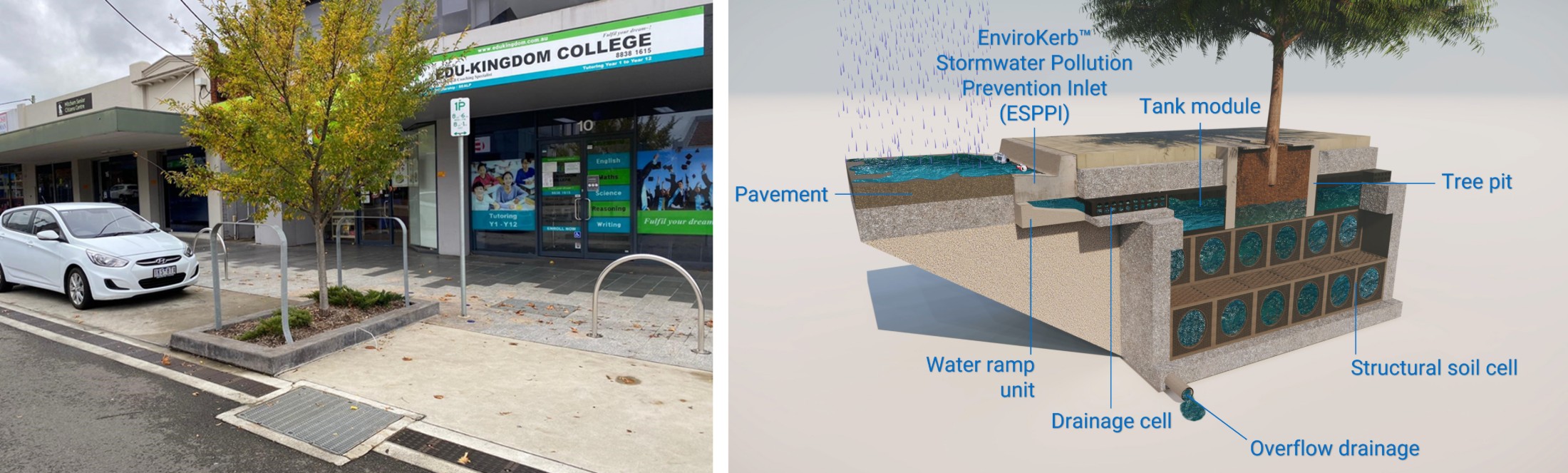
The Tree Pit System is the full expression of the system: a healthy street tree growing over a structural soil cell and tank module, fed by the EnviroKerb® and ETI. Where conventional drainage pipes water past the tree, the Tree Pit System routes it into the root zone. The canopy is passively watered on every rain event while runoff is retained at the source.
Classification. An urban green infrastructure element within the meaning of SA HB 214:2023. Under the IPWEA Green Infrastructure Management Manual, a hybrid green infrastructure asset – a street tree with a pit.
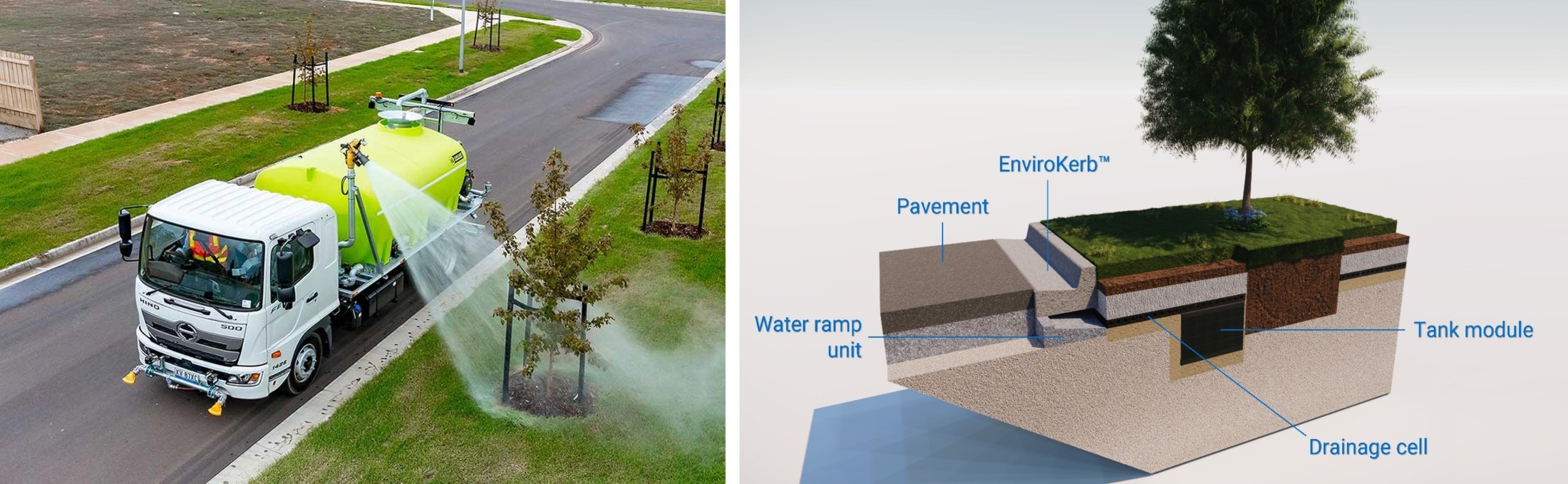
For grassed verges and landscaped medians, the Nature Strip variant turns the everyday strip between kerb and footpath into working green infrastructure. The EnviroKerb® and a water ramp unit feed a tank module and drainage cell beneath the turf. Moisture held in the profile keeps the strip green and the runoff out of the pipe.
Classification. An urban green infrastructure element within the meaning of SA HB 214:2023.
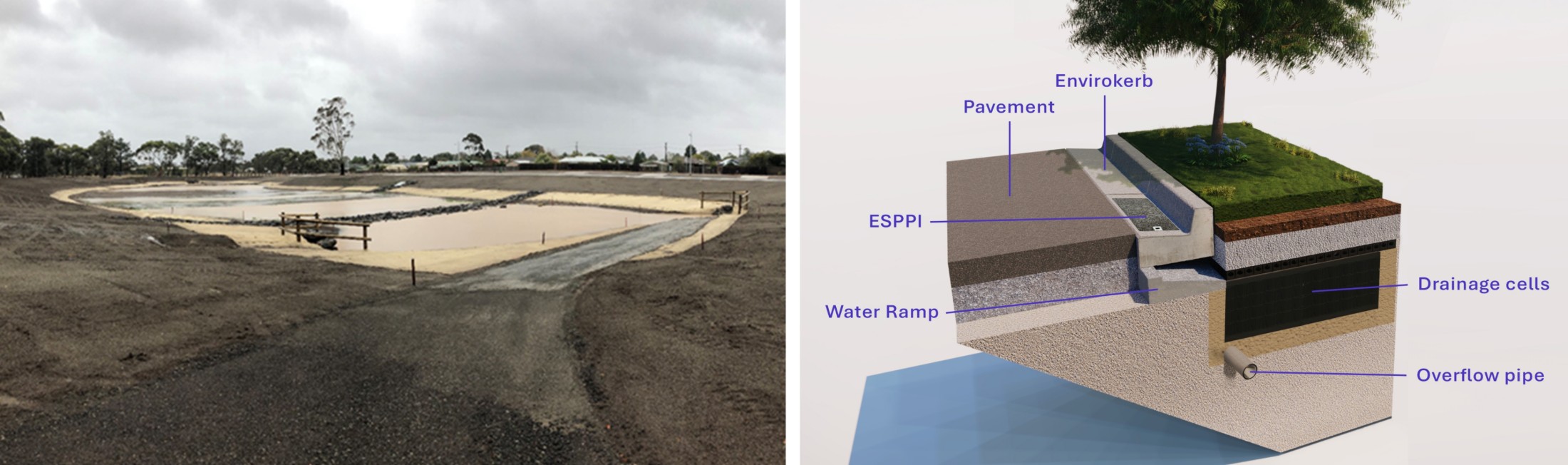
Where the priority is retention volume and flood mitigation, the Storm Retention variant puts the storage to work beneath the pavement. The EnviroKerb® and ETI feed a water ramp unit, drainage cells and tank module sized to detain and slowly release water – reducing peak discharge to the network and recharging groundwater below.
Variant 03 is the quantity unit, with storage beneath the pavement fed by runoff through the EnviroKerb®. Holding the runoff at the kerb line reduces the flow that the network downstream is designed on. It suits the places where there is no room for a tree and the problem is volume.
Classification. Outside the definition of urban green infrastructure – this variant carries no major vegetation element. Under the IPWEA Green Infrastructure Management Manual it is an engineered asset supporting green infrastructure.
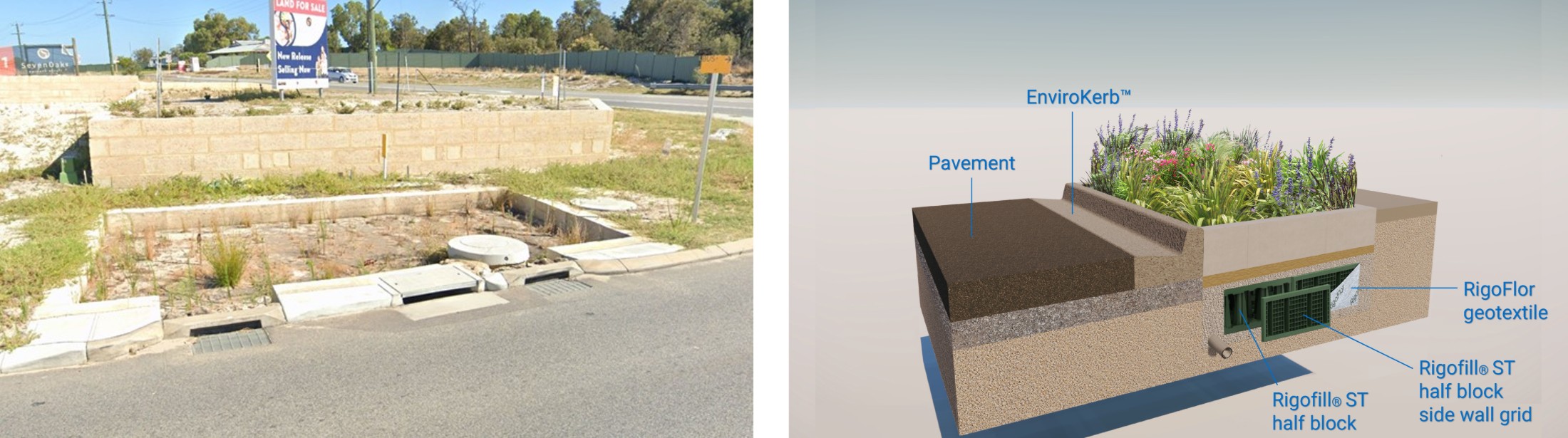
Storm Retention – Planted pairs an amenity planted surface with high-capacity modular storage below. The planted surface sits over geotextile-wrapped drainage cells and tank modules. The variant combines the amenity and canopy of a planted bed with the retention volume of modular storage in one source-control footprint. Storage depth and volume are set by the calculated inflow for the catchment; the cutaway shows an indicative half-height arrangement.
Classification. An urban green infrastructure element within the meaning of SA HB 214:2023.
Tell us the street, the constraints and the outcome you're after – we'll map the right configuration and provide the standard details.