Rain falling on a green, tree-lined street
Climate-resilient urban water management

A sponge city, beneath the street.

The Tree Nurturing System (TNS™) captures, cleans and infiltrates stormwater where it falls – cooling the city, protecting waterways, and keeping street trees alive.

Patented & trademarked proprietary system
Founder is a Chartered Professional Engineer (CPEng)
Decentralised, modular & retrofittable
Integrates the EnviroKerb™ porous kerb
The problem

Conventional drainage fights the water cycle. It loses.

Centralised pit-and-pipe drainage is built to remove water from a single point as fast as possible. Efficient at moving water – but it disrupts the natural cycle that keeps soil, waterways and trees alive.

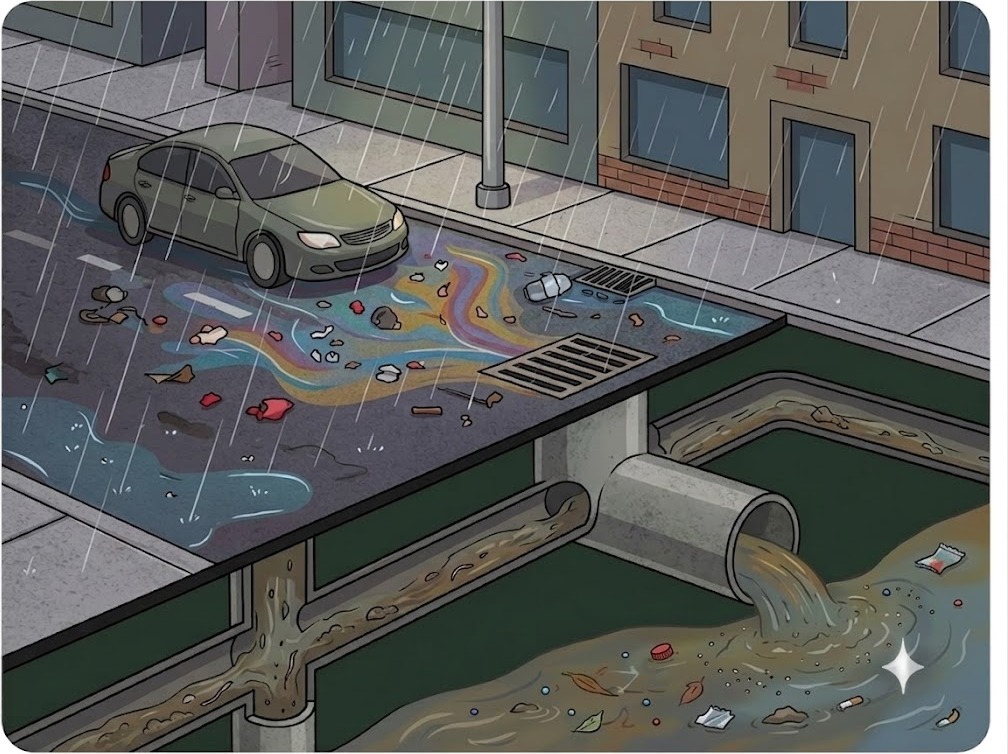
Polluted stormwater runoff carrying litter and oil into a drain and out to a waterway
01

It mobilises pollutants

Traditional systems collect and convey contaminants downstream, detrimentally impacting the health and function of the receiving environment.

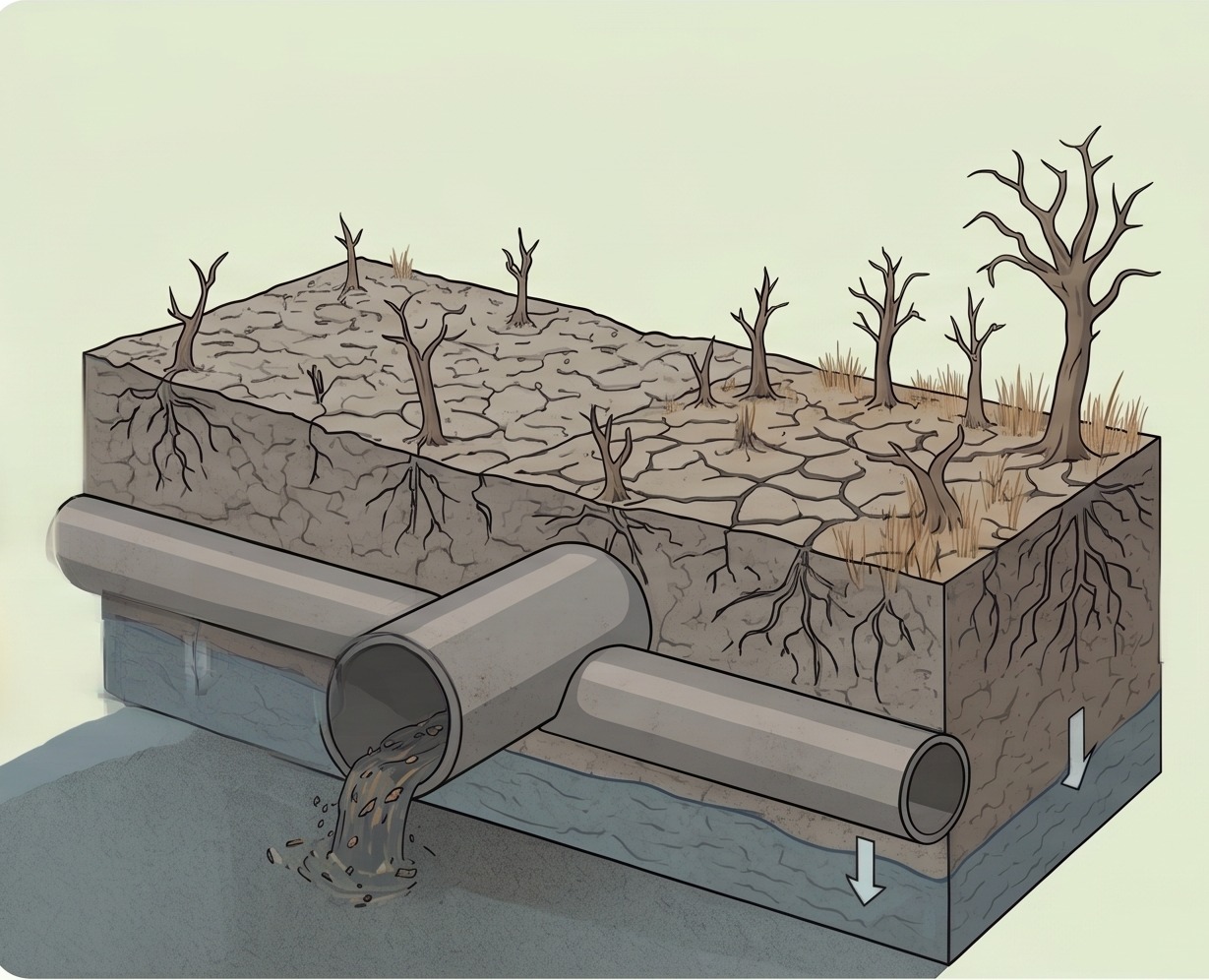
Cracked, barren soil with dead trees as water is piped away below
02

It starves upstream catchments

Rainfall is piped away, leaving dead, barren soils. Groundwater falls deeper; soils lose oxygen, minerals and elements, and become hard and compacted.

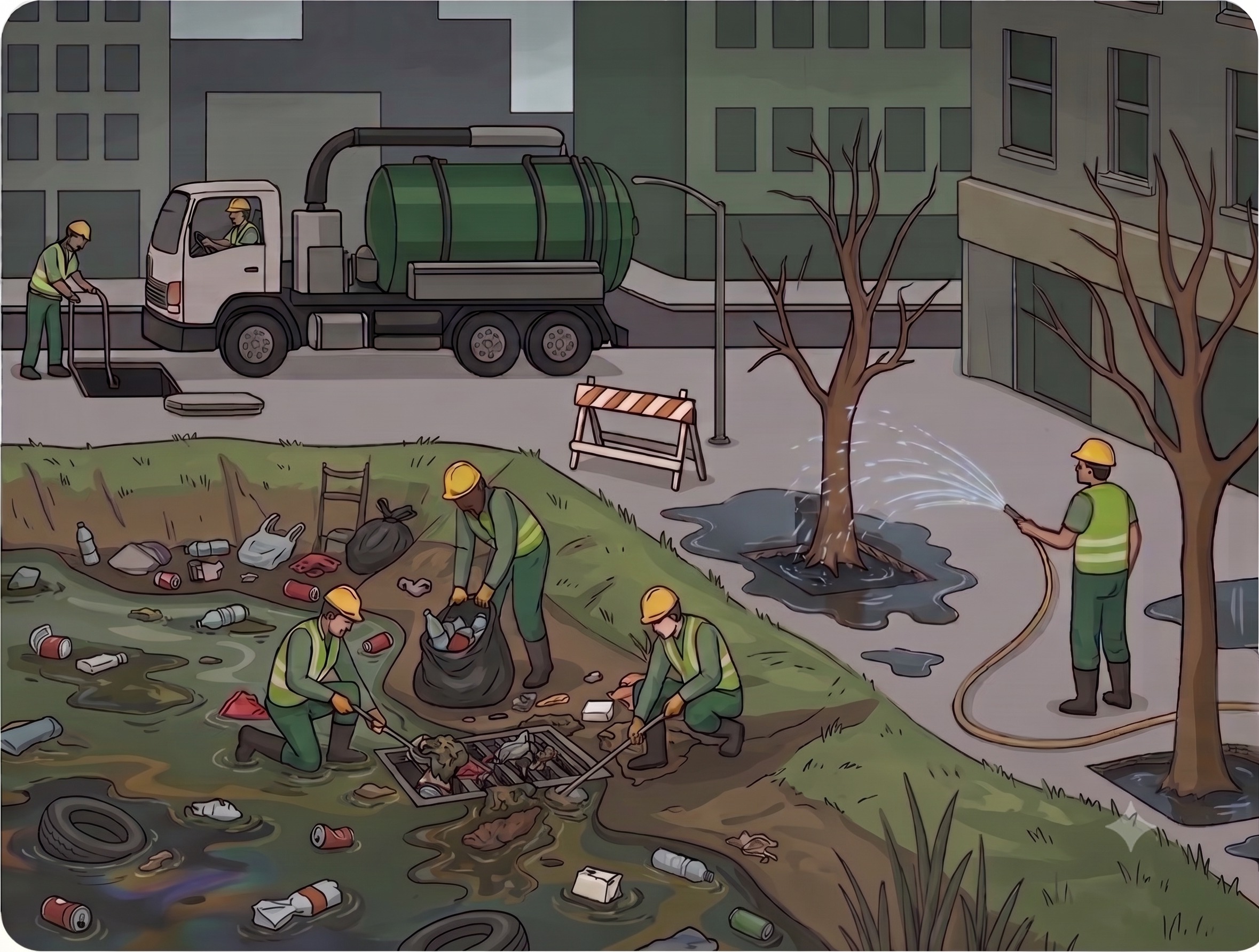
Crews vacuum-cleaning drains and hand-watering struggling street trees
03

It locks in costly maintenance

The standardised approach commits cities to a significant end-of-line maintenance regime, alongside costly, time-consuming and insufficient manual irrigation.

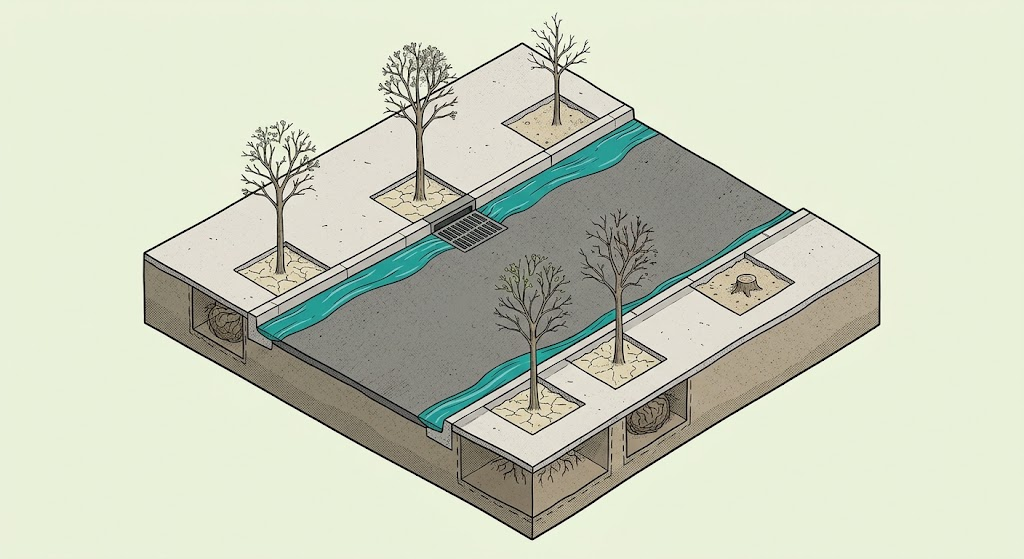
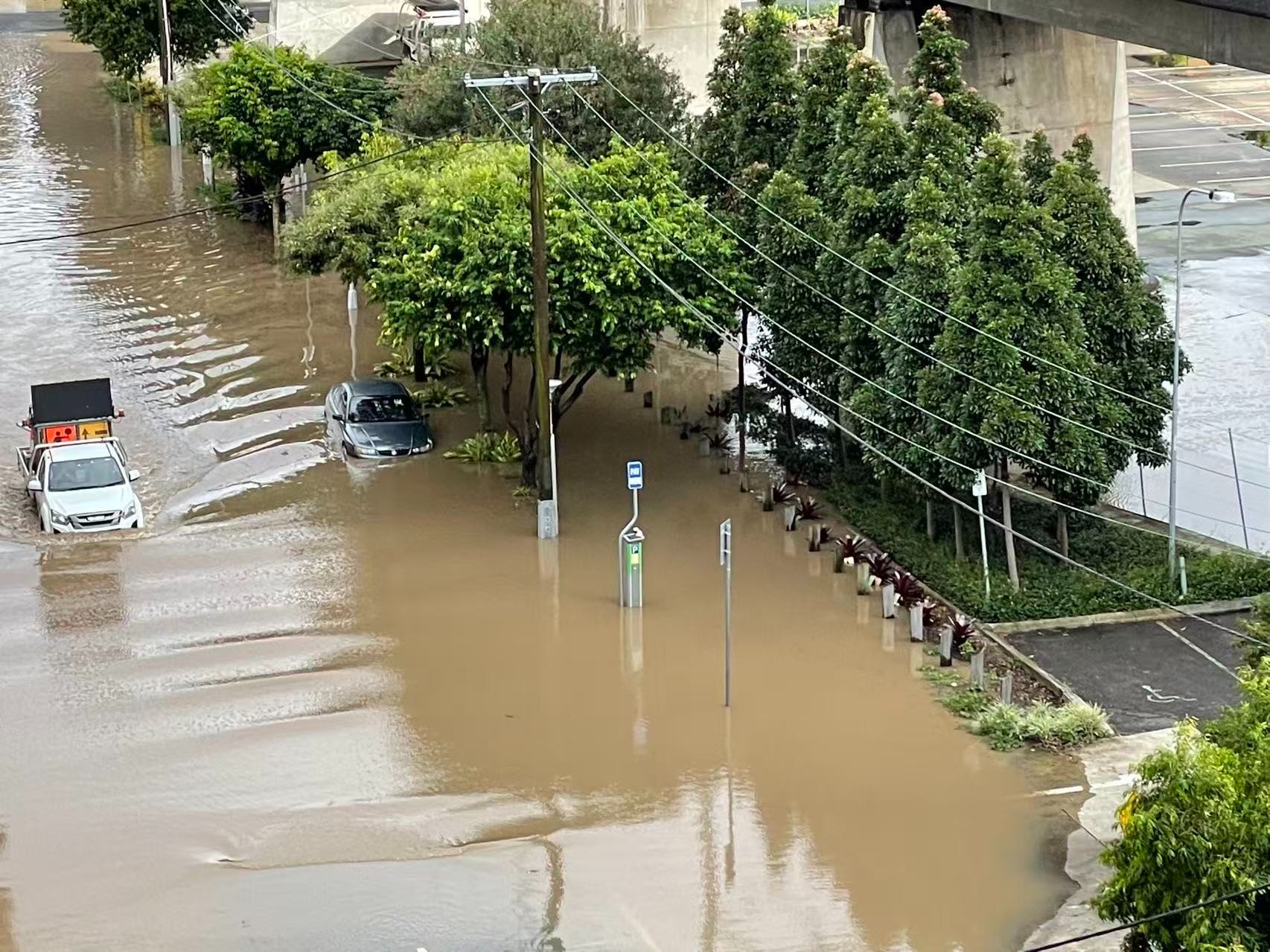
A city street under floodwater – sealed roads with nowhere for the rain to drain
When the city is one impermeable crust, the rain has nowhere to go. Sealed surfaces shed every drop at once – overwhelming the network and putting the storm in the street.

The hidden climate cost of conventional stormwater.

Conventional drainage isn't climate-neutral plumbing. Every storm, it drives the very climate impacts cities are fighting – degraded waterways, urban heat, and lost water security.

Strong · Queensland

It degrades estuaries and seagrass

Drainage flushes sediment and nutrients straight to receiving waters, where turbidity blocks light and smothers seagrass. TNS captures and filters runoff at the source, so less reaches the bay.

Read the evidence

In Queensland, Moreton Bay's seagrass decline has been attributed largely to stormwater sediment and nutrient loads; higher sediment loads non-linearly shrink seagrass habitat.

Strong (streams)

It heats our waterways

Runoff sheets across sun-baked pavement, picks up heat, and carries it into creeks and downstream estuaries – stressing aquatic life and lowering oxygen. TNS infiltrates runoff into cool soil instead of discharging it warm.

Read the evidence

Runoff from hot impervious surfaces can exceed 39 °C, and overseas studies document post-storm stream-temperature surges of 7–9 °C. The extension to downstream estuaries is a recognised risk pathway rather than a measured marine figure.

Established

It worsens urban heat

Draining water out of the landscape leaves no stored moisture for the evapotranspiration that cools cities, intensifying the urban heat island. TNS holds water in the soil to sustain vegetation and its cooling.

Read the evidence

Evapotranspiration from well-watered vegetation is a core cooling mechanism in water-sensitive urban design; remove the water and you remove the cooling.

Established

It erodes streams and drains groundwater

Rapid conveyance sends erosive peak flows through channels, strips groundwater recharge, and leaves streams to dry between storms – ‘urban stream syndrome’. TNS slows, stores and sinks flow to restore baseflow.

Read the evidence

Hydrologic ‘flashiness’ from impervious catchments drives channel erosion, habitat loss and reduced dry-weather flow – a well-documented degradation syndrome.

BGI research

Hot surfaces may amplify the damage

Rain interacting with hot, low-albedo surfaces – and the pollutants mobilised off them – may amplify downstream thermal and water-quality impacts. Source control like TNS intercepts runoff before this can compound.

Read the evidence

This is an area of active BGI research and our working hypothesis (Richards, 2023), not settled science – presented to flag a question we're investigating, not an established result.

All of it – the floods, the heat, the dying waterways – shows up on your street as one thing you can actually see.

And it's killing street trees.

Many urban street trees are planted in shallow graves, surrounded by hard, compacted engineered soils – root zones starved of water, oxygen and minerals. Declining immunity lets pathogens like phytophthora attack the cell structure, slowly and surely. Without a healthy root mass to hold the trunk and canopy, trees fail and collapse – and in many urban areas, that costs community lives.

An uprooted street tree, its root plate torn from the ground, fallen across and crushing a parked car
Business as usualStarved roots fail – and trees collapse, at real cost to communities.
The solution
TNS™ – Tree Nurturing System

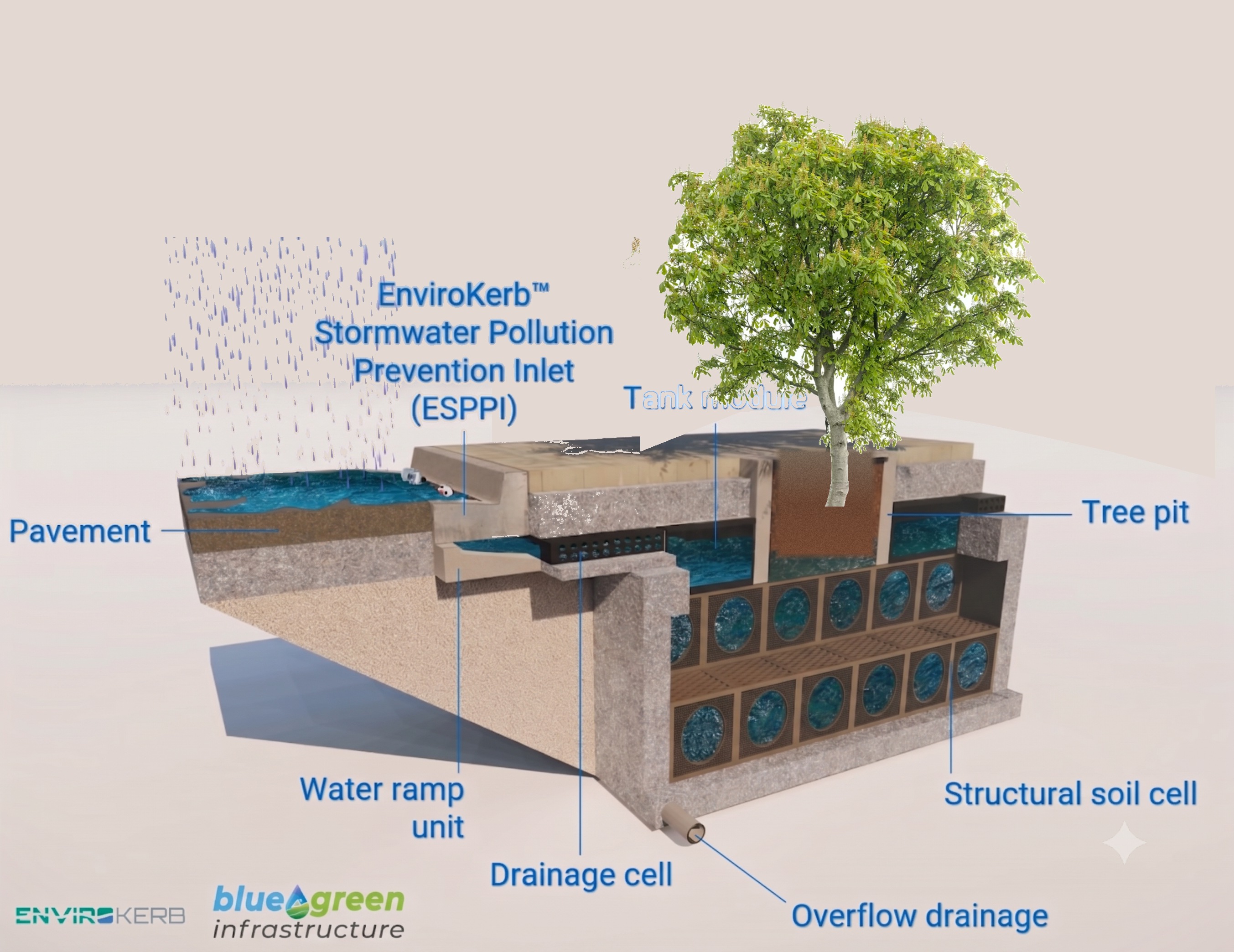
Imagine a system that works like a sponge in nature. The TNS™ soaks up rainwater, cleans it, and gently releases it where it's needed most – to urban trees and plants – while letting the excess seep down to replenish groundwater. A decentralised, source-control approach: slow it, store it, sink it.

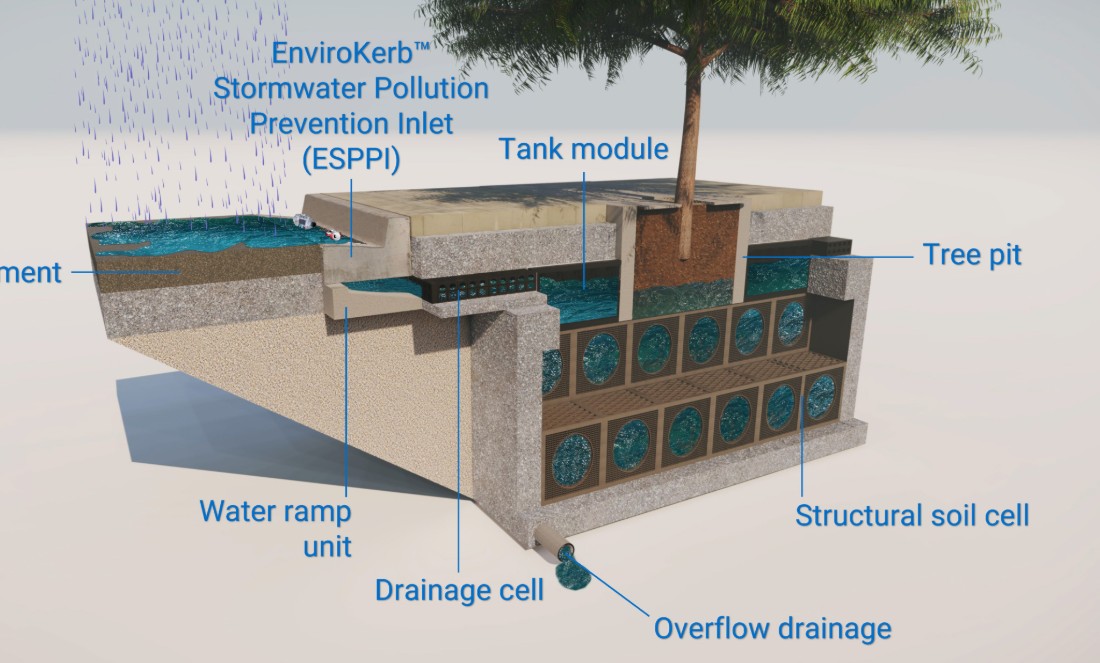
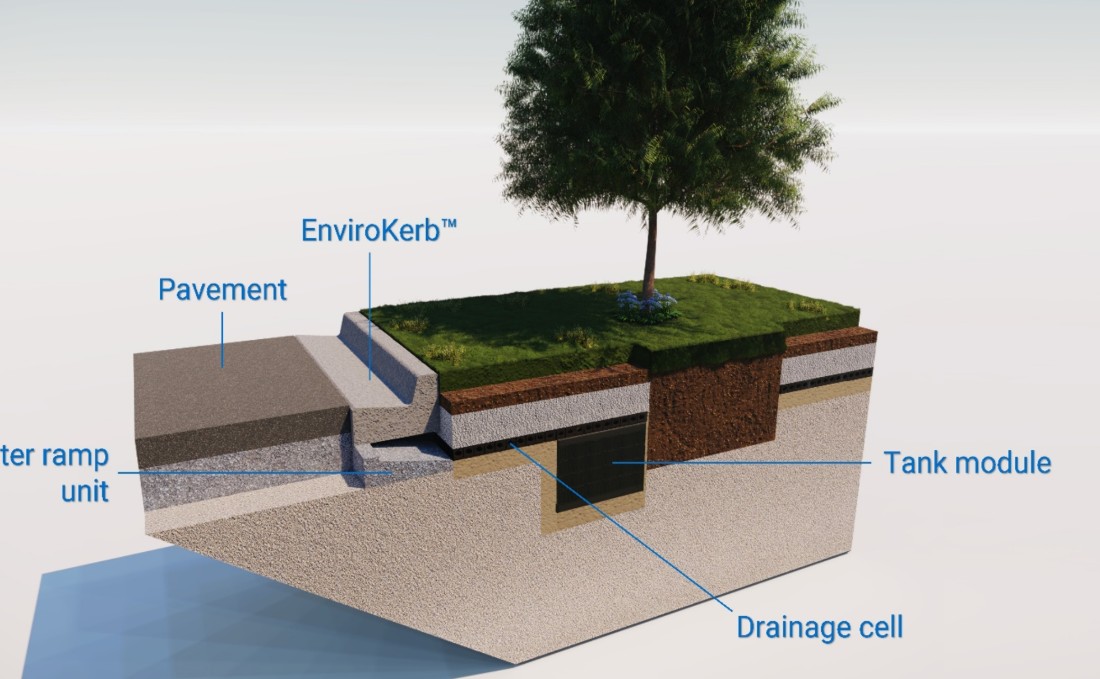
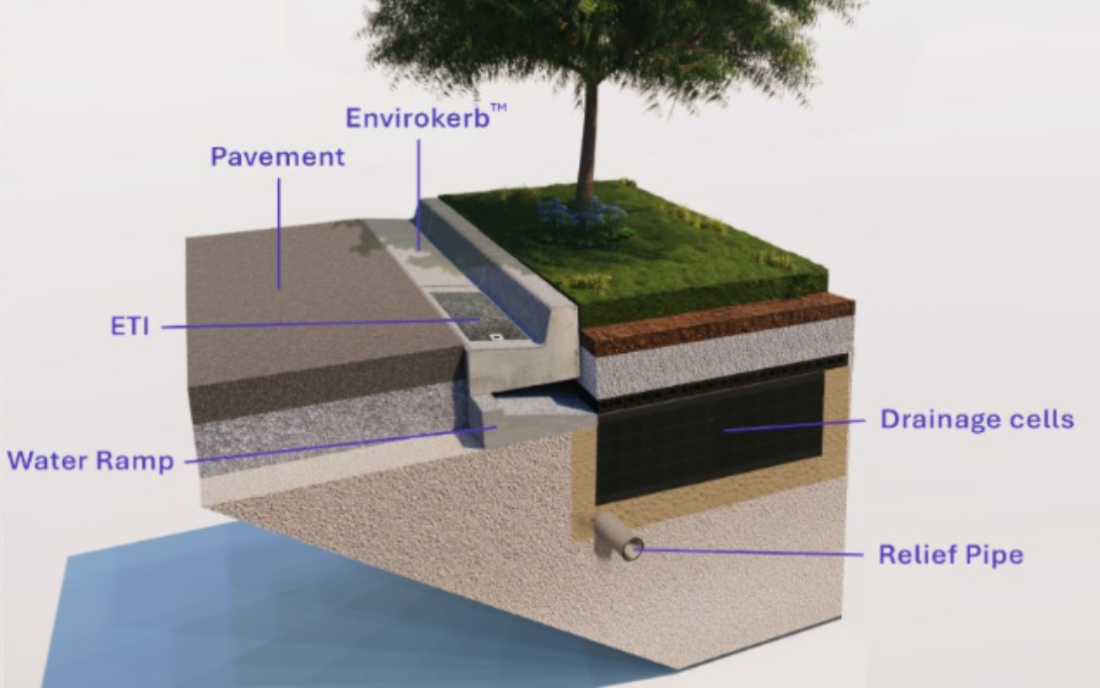
TNS™ cutaway – rain enters via the EnviroKerb and ESPPI, through pavement, water ramp, drainage cell and tank module to the tree pit, structural soil cell and overflow drainage
TNS™, in cross-section: rain enters through the EnviroKerb™ and ESPPI, fills the tank and soil cell, feeds the root zone, and lets the excess seep away through overflow drainage.

The combined systems of soil, water and vegetation – known as blue-green (living) infrastructure – moderate the release of water in heavy rainfall and provide fresh water through heatwaves. This fosters vegetation growth, expands tree canopy, and lowers urban heat.

Unlike conventional drainage, the TNS™ is a decentralised approach. That decentralisation significantly reduces the displacement of flows and volumes – mitigating rapid runoff and pollutant mobilisation by a magnitude of scale.

Decentralised by design

Source control reverses the logic of conveyance. By slowing, storing and sinking runoff, the system reconnects urban environments to natural hydrological processes.

Modular – like Tetris beneath the street

Each unit manages its own micro-catchment. Units arrange wide or narrow, deep or shallow, independently or connected – added, removed or rearranged to suit local space, grade and site constraints.

Retrofittable, anywhere

Ideal for retrofitting existing streets without costly excavation or redesign – adapting from dense urban streets to open landscapes while holding consistent infiltration and water-quality performance.

Flood & drought resilience Reduced erosion Enhanced biodiversity Regulated local temperatures Clean water Groundwater recharge
How it works

An exceptional inflow rate, and a complete treatment train.

The TNS™ distinguishes itself from other tree-pit devices through its inflow rate and its comprehensive approach to stormwater management.

EnviroKerb™ – porous concrete kerb · PPC Australia

A fully porous kerb – a super-filter for rainwater.

An eco-friendly sponge made from special concrete. Placed along kerbsides, it cleans runoff as it flows so clean water reaches trees and plants – and filters runoff before it enters the tree pit, with treatment efficiency well above other systems. Learn more at envirokerb.com.au →

Water quality

Nature does the cleaning.

Porous media – whose voids collect oxygen, nutrients and minerals – support algae and bacteria that feed on runoff contaminants, including hydrocarbons. Intercepted under shallow sheet-flow, constituents stay microscopic, minimising accumulation and sustaining high flow-rate performance over time.

ESPPI – EnviroKerb™ Stormwater Pollution Prevention Inlet

Gross pollutants never enter the network.

The removable-tray ESPPI protects waterways and oceans from plastic, litter and substantial pollutants. Unlike pit-and-pipe systems, gross pollutants remain in the tray of the porous kerb – so maintenance is dramatically simpler: only a street sweeper is required.

Customisable – up to a
1-in-100-year storm.

The key differentiator is the decentralised approach, which reduces the negative impacts of conventional drainage by a magnitude of scale. Through a range of proprietary stormwater-management solutions, the TNS™ is configured for both minor and major rainfall events.

Runoff retention, distributed detention and slowing the water significantly reduce flood risk, replenish groundwater, and protect downstream water systems – while maintaining ecosystem health.


ESPPI – first-flush capture. A removable tray for easy maintenance, placed upstream to intercept the first flows.
EnviroKerb™ – high-flow infiltration. The fully porous kerb sits downstream, adjacent to the ESPPI, to admit the high flows.

How they work together: the ESPPI sits upstream to manage the first flush, with fully porous EnviroKerbs™ downstream, adjacent to it, taking the high flows. The number of units is calculated from the micro-catchment runoff calculations.

~98%
gross pollutant removal from road runoff
~30,000mm/hr
EnviroKerb™ inflow capacity (500 mm/min)
1-in-100yr
storm event the system can be configured for
A sweeper
routine maintenance – nothing proprietary to service

Sources: EnviroKerb™ inflow capacity from PPC Australia falling-head infiltration-cone testing (envirokerb.com.au). TNS™ treatment efficiency from MUSIC modelling, supported by multiple sources and live projects.

Live monitoring · Matter integration

Every node, watched in real time.

Matter SensAI sensors measure flow against a calibrated baseline, so a drop flags an inspection before it becomes a blockage – turning maintenance from a fixed schedule into a predictive, data-driven response.

See the full Matter integration →
Technology partners

Matter (watermatters.ai) – digital water-risk intelligence. BGI integrates Matter's SensAI radar-and-AI sensing for real-time stormwater and flood monitoring. See how it integrates →

The system

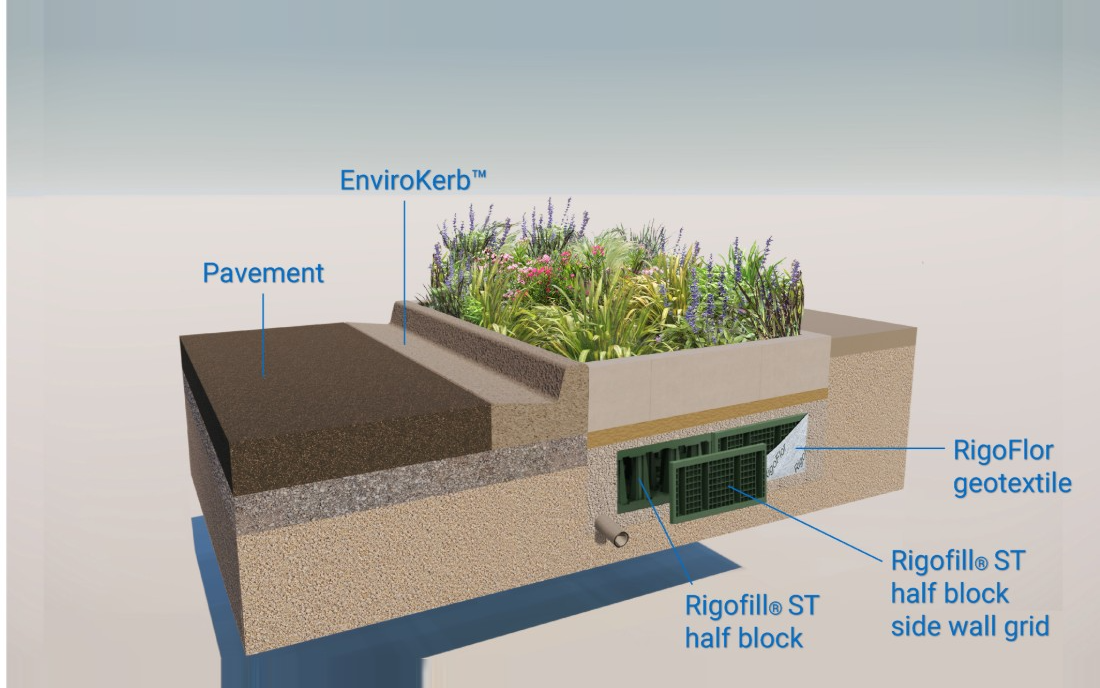
Four modular variants of the TNS™.

Integrating proprietary modular tank, structural cell and drainage void systems – configured to depth, capacity and site type.

Re-introducing cultural water values
An Aboriginal woman drinking fresh water gathered from the land at the water's edge

Water is a living system – intrinsically connected with land, culture and community. Our approach reflects the enduring principle that water should return to Country and sustain life.

Aligned with Australia's National Water Initiative (2004), the Insights Paper – Pathway to Enduring Recognition of Aboriginal Peoples' Water Interests (2022), and the forthcoming National Water Agreement.

Why it's defensible

Proprietary technology, riding a global shift.

01

Patented & trademarked

The Tree Nurturing System (TNS™) is owned and licensed by Blue Green Infrastructure Pty Ltd. The patent is made, and the TNS™ trade mark used, under licence from BGI.

02

A modular, integrated system

Four modular variants integrate proprietary tank, structural cell and drainage void systems – a practical bridge between policy intent and real-world implementation.

03

Aligned with the policy direction

Growing national and international recognition that water is a living system – the National Water Initiative, recognition of Aboriginal Peoples' water interests, and the forthcoming National Water Agreement.

04

A magnitude of scale

The decentralised, source-control approach reduces the negative impacts of conventional drainage by a magnitude of scale – runoff retention, distributed detention, and slowing the water.

Partner with us

Let's put the sponge back under the street.

Whether you're specifying WSUD for a council or development, or a capital partner backing climate-resilient infrastructure – start a technical conversation. We're an engineering-led company moving toward raising capital, and investment materials are available on request.

Brisbane, QLD · Australia

Prefer email? [email protected]